- An alkaline battery type D
- Tape
- Two paper clips (the larger the better)
- A rectangular magnet (such as those used in refrigerators)
- A toilet paper tube (with a small diameter)
- Thick enameled copper wire
- Sandpaper
- Optional: glue, small block of wood for the base
Instructions:
1. Roll the copper wire around the carton tube, 10 0r more times (in parallel coils), leaving at least 5cm from each unwound ends and PERFECTLY strait. Remove the tube since it is only used to build the coil. The wire can also be rolled around any other cylindrical objects. For example, the “D” type battery itself.
The ends must match. In other words, they must face each other since they are the shafts of our motor. You can either use a drop of glue between each turn or give two turns to the wire of the ends from the coil to prevent its distortion.
2. Using the sandpaper, completely remove the enamel of the wire of one of the ends of the coil. Leave at least 1 cm without sanding, the part that is closest to the coil.
3. Place the coil on a flat surface and sand the other end of the wire. Again, leave at least 1 cm without sanding, the part closest to the coil.
4. Fasten the magnet to one side of the battery by using glue.
5. Using the paper clips, leave two hooks on each end having between them an angle of 90 degrees. Flat pliers or with a fine tip can be very useful.
6. Use the tape to fasten a paper clip to each end of the battery, placing the ends on the same side of the magnet.
7. Hang the coil on the free ends of the clips. If the coil doesn’t spin, immediately you should slightly help it.
Explanation:
When we place the coil on the ends of the clips, we close the circuit so that a magnetic field is induced in each of the turns of the coil. The electric current is generated by the battery. Anyways, the electric field faces the magnet itself, originating the rotation of the coil. The coil will stop spinning when the electric current stops to flow. In other words, when the battery runs out since the wire is only sanded by one side of one of the ends of the wire and a static equilibrium of the whole will never be achieved. If both sides were sanded, equilibrium between the electric fields would be produced, generating no movement.
If the motor doesn't work, make sure that the clips are making contact with the poles of the battery, that their surfaces are well sanded, or change the lateral position of the magnet. These were some of the factors of why my motor didn't work.
*I couldn't post any images of my motor since it didn't work and I undid it before my teacher told me to provide an image of it in my post.
*I couldn't post any images of my motor since it didn't work and I undid it before my teacher told me to provide an image of it in my post.
Reviewing Electricity Goals:
Building the motor introduced me to a new topic: Electricity. Later on, we reviewed some concepts from 7th grade about the same topic. There were a total of eight goals we reviewed which are listed as follows:
1. I can explain how electric charges interact
2. I can give examples of how charges can be transferred between materials and explain them.
3. I can explain how an electric current is produced
4. I can compare conductors with insulators
5. I can explain how resistance affects current
6. I can use Ohm’s law to calculate resistance, current or voltage.
7. I can build series and parallel circuits and describe its parts.
8. I can explain the relationship between power, voltage and current.
There are three types of electric charges: protons (+), electrons (-), and neutrons (o). The relationship between them is simple: opposites attract and likes repel.


Charges can be transferred from one object to another by three methods. One of them is charging by friction, the transfer of electrons from one uncharged object to another by rubbing. The second method is charging by conduction, the transfer of electrons from a charged object to another by direct contact. The third way is charging by induction, the movement of electrons from a part of an object to another which is caused by the electric field of a second object.
An electric current is the continuous flow of electrons. It is produced by the continuous flow of charges from one place to another. In the following image of a car circuit, a simulation of what happens inside an current is present. The car circuit represents an electric current itself while the flowing charges are being represented by the cars.
Furthermore, there are four factors that determine resistance: type of material the wire is made, temperature, diameter and length of the wire. The type of material the wire is made of refers to whether it is a conductor or an insulator. If the wire is an insulator, it will make it difficult for electrons to move through the current since it has tightly held electrons. In other words, it has more resistance. If the wire is a conductor, it will make it easier for electrons to flow through the current since it has loosely held electrons. It has less resistance. The second factor is temperature. As temperature increases, the resistance of the wire increases too. In contrast, as the temperature decreases, the resistance of the wire does as well. The third factor includes the length of the wire. A short wire has less resistance than a long wire. Lastly, the fourth factor that determines resistance is the diameter of the wire. A wide wire has less resistance than a narrow wire.
charging by friction  |
| http://media.ehs.uen.org/html/PhysicsQ3/Charging_by_Friction_01/charging.jpg |
charging by induction |
| http://media.ehs.uen.org/html/PhysicsQ3/Conduction_and_Induction_01/induction1.jpg |
charging by conduction |
| http://media.ehs.uen.org/html/PhysicsQ3/Conduction_and_Induction_01/conduction.jpg |
An electric current is the continuous flow of electrons. It is produced by the continuous flow of charges from one place to another. In the following image of a car circuit, a simulation of what happens inside an current is present. The car circuit represents an electric current itself while the flowing charges are being represented by the cars.
Furthermore, there are four factors that determine resistance: type of material the wire is made, temperature, diameter and length of the wire. The type of material the wire is made of refers to whether it is a conductor or an insulator. If the wire is an insulator, it will make it difficult for electrons to move through the current since it has tightly held electrons. In other words, it has more resistance. If the wire is a conductor, it will make it easier for electrons to flow through the current since it has loosely held electrons. It has less resistance. The second factor is temperature. As temperature increases, the resistance of the wire increases too. In contrast, as the temperature decreases, the resistance of the wire does as well. The third factor includes the length of the wire. A short wire has less resistance than a long wire. Lastly, the fourth factor that determines resistance is the diameter of the wire. A wide wire has less resistance than a narrow wire.
 |
| http://www.woodentoys123.com/products/race-car-circuit-toy-1.jpg |
Conductors and insulators are different groups of materials. Insulators are materials through which charges can’t flow easily. Conductors are the opposite, they are materials through which charges can flow easily and are used to carry charge, and they have less resistance.

Resistance is the measure of how difficult it is for charges to flow through a material. When resistance increases, the current decreases. There are four factors that determine resistance: the type of material, length of the wire, diameter of the wire, and temperature.
Ohm’s law is used to calculate resistance, current or voltage. The equation is resistance equals voltage divided by current (R=V/C). When resistance increase and current remains the same, voltage increases. On the other hand, when resistance decreases and voltage remains the same, current decreases.
 |
| http://www.hondaforeman.com/attachments/how/7309d1318956570-electrical-system-explained-how-500px-ohms-law-triangle.jpg |
There are two types of circuits: parallel and series. A parallel circuit has several paths while a series circuit has only one. The different parts of a circuit are the energy source, resistors, and a switch. The energy source is what makes charges move around the circuit. A resistor resists the flow of an electric current. The switch is used to open and close the circuit.


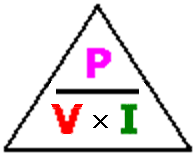
Another essential formula in electricity is P=VI, which represents the relationship between power, voltage and current. P represents power, V represents voltage, and I represents current. Power is the rate where one type of energy is transformed into another.
 |
| http://www.sengpielaudio.com/FormulaPower01.gif |
Self-Reflection:
In my opinion, building an electric motor helped me visualize how it works more easily. It was a more didactic and entertaining way of learning instead of just reading the book. Same thing goes with the goals. By performing different types of activities to learn, it helps maintain the concepts in my mind without the need of memorizing it.


